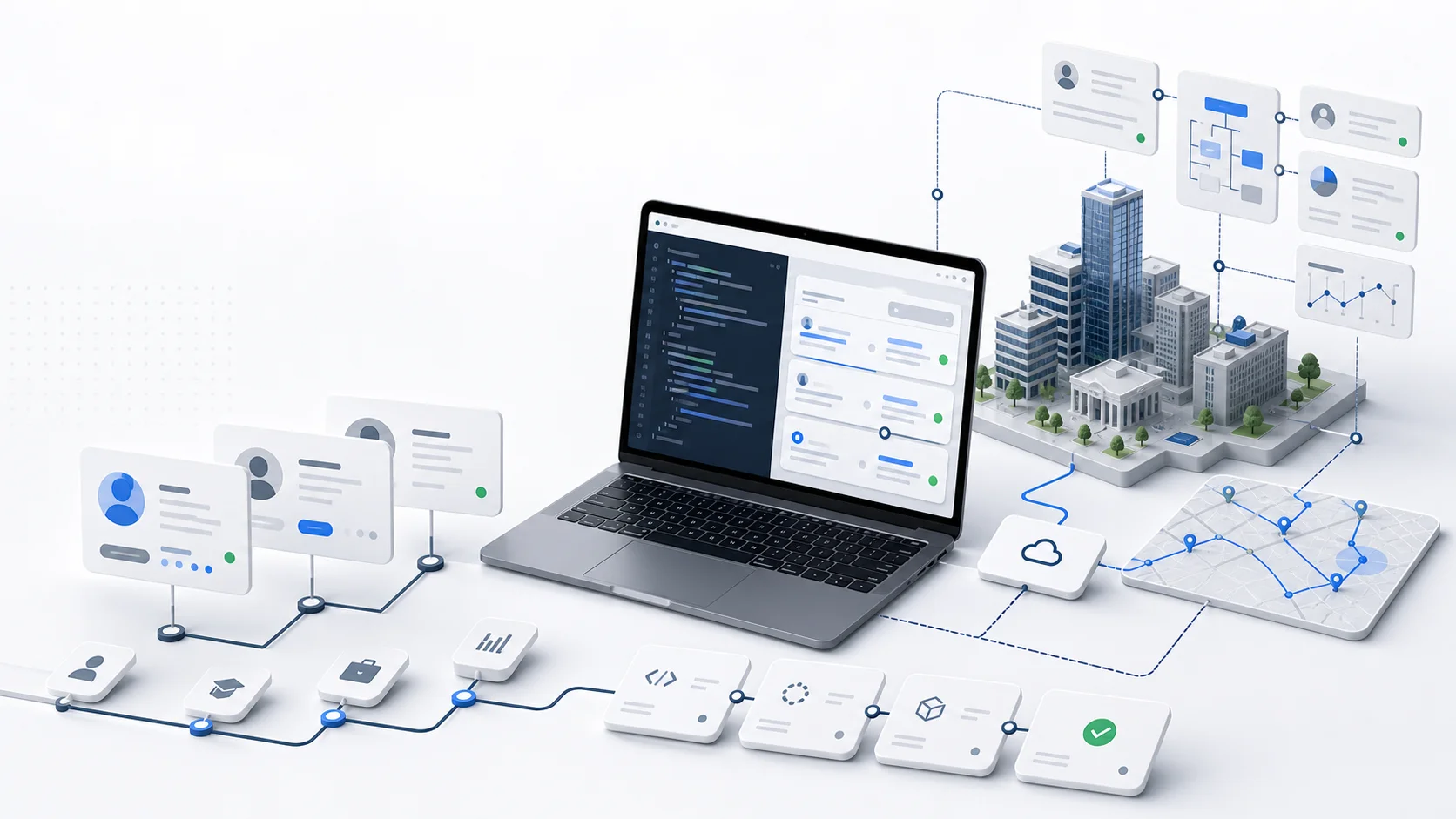
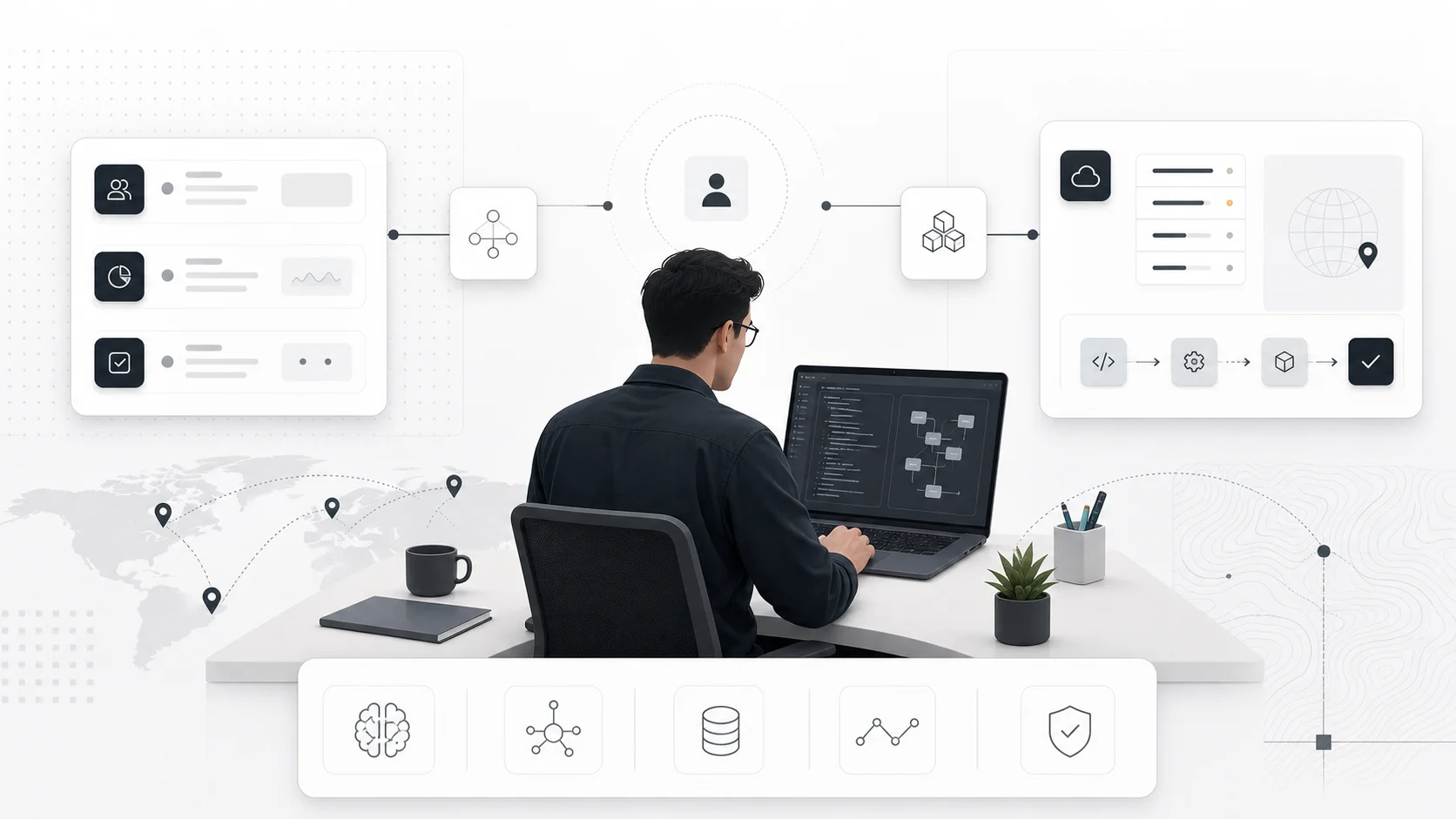
A Forward Deployed Engineer, often shortened to FDE, is a software engineer who works close to customers to design, build, integrate, and deploy technical solutions in the customer's real operating environment.
That definition sounds simple. The role is not.
At one company, a Forward Deployed Engineer might spend most of the week writing production code for an enterprise AI deployment. At another, the same title might mean configuring integrations, debugging data pipelines, supporting a strategic account, or translating messy customer workflows into product requirements for the core engineering team.
That is why the better question is not just "what is a Forward Deployed Engineer?" It is:
What kind of Forward Deployed Engineer role is this company actually hiring for?
This guide explains the role clearly: what FDEs do, how the job differs from software engineering and solutions engineering, what skills you need, what salaries look like in 2026, and how to tell whether an FDE job is a real engineering role or a customer-facing implementation role with a new title.
Quick Answer: What Is a Forward Deployed Engineer?
A Forward Deployed Engineer is a customer-facing engineer who builds and adapts software in the environment where it will actually be used. FDEs sit between product engineering, customer success, solutions architecture, and implementation. Their job is to turn a customer's real workflow into working software, then feed what they learn back into the product.
In practice, FDEs often:
Write code for customer-specific deployments
Build integrations with internal systems, APIs, databases, and third-party tools
Prototype new workflows with users
Debug production issues in messy enterprise environments
Translate operational problems into technical requirements
Help customers move from proof of concept to production
Identify product gaps that core engineering should solve for future customers
The role was popularized by Palantir's Forward Deployed Software Engineer model, but it has spread into enterprise software, data platforms, robotics, fintech, defense tech, and especially AI companies.
The rise of AI has made the role more visible. Many companies can demo impressive models. Far fewer can make those models work inside a bank, hospital, logistics network, insurer, government agency, or Fortune 500 back office. Forward Deployed Engineers exist because that last mile is usually where software projects fail.
Why Forward Deployed Engineers Exist
Most software teams build for a generalized user. They collect requirements, write tickets, ship features, and hope the product maps cleanly onto the customer's real workflow.
Forward Deployed Engineers work in the opposite direction. They start with the real environment.
That matters because enterprise software almost never enters a clean room. It enters a company with:
Legacy systems nobody fully owns
Data quality problems hidden until integration starts
Security and compliance constraints
Undocumented workflows
Users who describe the official process, then behave differently in practice
Internal politics around who owns the new system
Existing tools that cannot simply be replaced
A normal handoff-heavy delivery model struggles here. Sales understands the customer's promise. Solutions architects understand the target design. Product engineers understand the platform. Customer success understands adoption. But the customer still needs someone who can sit in the middle of all of it and make the thing work.
That person is the FDE.
The role is especially important in AI because AI deployment is not only a software integration problem. It is also a workflow design, data readiness, evaluation, reliability, and change management problem. A model can perform well in a demo and still fail in production because the source data is inconsistent, the retrieval layer misses critical context, the evaluation set does not match real usage, or the proposed workflow does not match how employees actually make decisions.
An FDE does not just ask, "Can we build this?"
They ask, "Can this customer actually use this in production, with their data, their constraints, their users, and their definition of success?"
What Does a Forward Deployed Engineer Do?
The day-to-day work depends heavily on the company, product, and customer. Still, most strong FDE roles follow the same lifecycle: discover, design, build, deploy, stabilize, and feed lessons back into the product.
1. Understand the Customer's Real Workflow
FDE work usually begins before the technical solution is obvious.
An FDE might interview users, inspect existing tools, map data flows, review API documentation, observe manual workarounds, and translate business goals into technical constraints. This is not passive requirements gathering. Good FDEs look for the gap between what the customer says happens and what actually happens.
For example, a logistics company might say it wants an AI assistant for operations planning. The FDE may discover that the real problem is not the chatbot interface. It is that shipment status data lives across five systems, exception handling is done in spreadsheets, and the highest-value decisions are made by two senior operators who use undocumented judgment.
The FDE's job is to find that truth early, before the team builds the wrong product.
2. Design the Technical Approach
Once the workflow is understood, the FDE helps decide what should be built.
That might include:
Architecture for a customer-specific deployment
API and integration design
Data ingestion and transformation plans
Authentication and permission models
Cloud or on-prem deployment constraints
LLM retrieval architecture
Evaluation criteria for AI outputs
Monitoring and reliability requirements
Handoff plans for the customer's internal team
This is where FDEs differ from pure implementation consultants. They are not only following a playbook. They are making engineering decisions under real-world constraints.
3. Build, Integrate, and Ship
This is the section to inspect carefully when evaluating an FDE job description.
In a strong FDE role, the engineer writes code and owns technical delivery. They may build backend services, data pipelines, frontend tools, scripts, internal dashboards, integrations, or AI workflows. The code might live in the core product, in a customer-specific extension, in a deployment repository, or in reusable templates that later become productized.
In a weaker or less engineering-heavy FDE role, the work may be mostly configuration, demos, workflow setup, customer training, and escalation management.
Both kinds of work can be valuable. They are just different jobs.
If you are a candidate, ask directly:
What percentage of the role is coding?
Does the FDE own production code?
Where does that code live?
Who maintains the deployment after launch?
How often does field-built work become part of the core product?
The answers tell you whether the role is closer to software engineering, solutions architecture, or implementation.
4. Deploy in the Customer's Environment
Deployment is where FDEs earn their title.
The customer's environment may include security reviews, procurement constraints, strange networking rules, data access restrictions, legacy systems, role-based permissions, compliance requirements, and stakeholders with competing priorities.
An FDE has to keep the solution moving through that reality. They may work with security teams, IT administrators, business operators, data owners, product managers, and internal engineers. They need enough technical depth to debug issues and enough communication skill to keep everyone aligned.
This is why FDEs are often described as "embedded" with customers. They do not simply ship code over the wall. They stay close enough to see whether the system works in context.
5. Stabilize, Measure, and Iterate
A deployment is not successful because it launched. It is successful because users adopt it and the customer gets measurable value from it.
After launch, FDEs may:
Monitor usage and reliability
Fix deployment-specific bugs
Improve prompts, retrieval, or data transformations
Add missing workflow steps
Remove friction from the user experience
Document the deployment for support or internal teams
Measure ROI, time saved, accuracy, throughput, or adoption
For AI systems, this phase is critical. The first version often exposes gaps in the data, evaluation method, user workflow, or product assumptions. The FDE closes that loop.
6. Feed Product Lessons Back to Engineering
The best FDE teams do not become permanent custom development shops. They turn field learning into product leverage.
If three customers need the same integration pattern, it should probably become a reusable connector. If every AI deployment needs the same evaluation harness, that should become internal tooling or a product feature. If users keep ignoring a workflow step, product should understand why.
This feedback loop is the strategic value of forward deployed engineering. FDEs solve the customer's immediate problem, but they also teach the company what the market actually needs.
Forward Deployed Engineer vs Similar Roles
FDE is a hybrid role, so confusion is normal. The easiest way to understand it is to compare what each role owns.
Role | Primary ownership | Typical stage | How much do they build? | Main success metric |
|---|---|---|---|---|
Forward Deployed Engineer | Customer outcome and technical deployment | Usually post-sale, sometimes pre-sale for strategic accounts | Medium to high; varies by company | Working software in production |
Software Engineer | Product features and platform quality | Product roadmap | High | Scalable product improvements |
Solutions Engineer | Technical validation during sales | Pre-sale | Low to medium; demos and prototypes | Deal support and technical fit |
Sales Engineer | Technical sales support | Pre-sale | Low | Revenue and customer confidence |
Solutions Architect | System design and architecture | Pre-sale and post-sale | Low to medium | Feasible architecture and integration plan |
Implementation Engineer | Rollout and configuration | Post-sale | Low to medium | Successful onboarding and go-live |
Customer Success Engineer | Adoption and technical support | Post-sale | Low to medium | Retention, usage, expansion |
FDE vs Software Engineer
A traditional software engineer usually builds for the product roadmap. Their work should scale across many customers. They may never meet the end user directly.
An FDE builds closer to one customer or a small set of strategic customers. Their work may be less polished at first, but it is grounded in real usage. Strong FDEs still need software engineering judgment: they must know when to write a quick customer-specific fix and when to design something reusable.
If you want deep systems work, stable product ownership, and fewer meetings, a standard software engineering role may be a better fit. If you want ambiguity, user contact, business context, and fast feedback, FDE can be more rewarding.
FDE vs Solutions Engineer
Solutions engineers usually help customers understand whether a product can solve their problem. They often build demos, answer technical questions, run proofs of concept, and support sales teams.
FDEs usually go deeper into delivery. They are more likely to build production integrations, adapt workflows, and stay involved after the sale.
The boundary is blurry. Some companies use "Forward Deployed Engineer" for what is essentially a senior solutions engineering role. The test is simple: does the role own production outcomes, or does it mainly help close deals?
FDE vs Sales Engineer
A sales engineer is tied closely to revenue. They help prospects evaluate the product, handle technical objections, and support account executives.
An FDE may support strategic sales conversations, especially at startups, but the strongest FDE roles are not quota-carrying sales jobs. They are engineering roles measured by deployment success, customer value, and product learning.
If the job description emphasizes pipeline, demos, account expansion, and sales targets more than building and deployment, treat it as sales engineering unless proven otherwise.
FDE vs Solutions Architect
Solutions architects design systems. They map requirements to architecture, select components, and guide implementation.
FDEs may do architecture work, but they are also expected to build and adapt the solution when the plan hits reality. A useful shorthand:
Solutions architects design the bridge. FDEs help build it while people are already trying to cross it.
FDE vs Implementation Engineer
Implementation engineers help customers configure and launch a product. They may write scripts, connect APIs, migrate data, or troubleshoot setup issues.
FDEs overlap with implementation engineering, but the role usually has more ambiguity and technical ownership. If a deployment requires custom software, new architecture, or deep product feedback, it is closer to FDE work. If it follows a repeatable checklist, it is closer to implementation.
The 4 Types of Forward Deployed Engineer Roles
The biggest mistake candidates make is assuming all FDE jobs are the same. They are not. Most roles fall into one of four types.
1. AI Forward Deployed Engineer
This is the fastest-growing version of the role.
AI FDEs help customers deploy AI systems into production. They may work on LLM applications, retrieval-augmented generation, agent workflows, model evaluations, data pipelines, prompt systems, integrations, and internal automation tools.
Common work includes:
Building prototypes with customer data
Designing evals for domain-specific outputs
Connecting AI systems to internal tools and databases
Improving retrieval quality
Creating human-in-the-loop workflows
Monitoring model behavior in production
Translating user feedback into product and model improvements
This role is attractive because many companies are stuck between AI demos and AI value. They need engineers who can close that gap.
2. Platform or Infrastructure FDE
Platform FDEs focus on the technical foundation: cloud environments, data platforms, deployment architecture, security, observability, networking, and enterprise integrations.
This role is common at companies selling infrastructure, developer tools, data platforms, cybersecurity products, or enterprise AI platforms. It tends to require stronger backend, DevOps, cloud, and systems knowledge.
3. Product-Focused FDE
Product-focused FDEs work with strategic customers to discover what the product should become.
They still build, but their highest leverage comes from turning repeated field problems into product features, reusable templates, internal tools, and roadmap insights. This version of the role is common at startups entering enterprise markets.
Good product FDEs have strong taste. They can tell the difference between a one-off customer request and a pattern that deserves to become product.
4. Implementation-Heavy FDE
Some FDE roles are closer to technical implementation or professional services. The work may involve configuration, workflow setup, integrations, training, troubleshooting, and account support.
These roles can be good careers, especially if you like customer interaction and business impact. But they may not build the same engineering portfolio as a role where you own production code.
Candidates should not reject implementation-heavy roles automatically. They should price them correctly, evaluate the growth path honestly, and avoid assuming they are equivalent to backend or AI engineering jobs.
Skills Needed to Become a Forward Deployed Engineer
FDEs need enough technical depth to build under pressure and enough communication skill to operate in ambiguous customer environments.
Core Technical Skills
Most FDE roles expect some combination of:
Python, TypeScript, JavaScript, Java, Go, or another production language
SQL and database fundamentals
API design and integration
Cloud platforms such as AWS, GCP, or Azure
Data pipelines and ETL basics
Authentication, permissions, and security concepts
Debugging across unfamiliar systems
Git, CI/CD, and deployment workflows
Basic frontend or internal tool development
You do not need to be the world's deepest specialist in every area. But you do need to be dangerous across the stack. FDE work often requires figuring out enough of a system to make progress quickly.
AI-Specific Skills
For AI FDE roles, add:
LLM APIs and model behavior
Retrieval-augmented generation
Vector databases and search
Prompt design and prompt evaluation
Agent workflows and tool calling
Model evaluation and benchmarking
Data privacy and governance
Human review workflows
Monitoring AI quality in production
The key is not just "knowing AI." It is knowing how to make AI useful inside a real organization.
Customer and Product Skills
The non-technical side is not optional.
Strong FDEs can:
Ask precise questions
Explain tradeoffs without hiding behind jargon
Handle vague or changing requirements
Build trust with technical and non-technical stakeholders
Write clear documentation
Push back when a customer asks for the wrong thing
Translate field lessons into product recommendations
Stay calm when a deployment breaks in front of users
This is why FDE roles often favor engineers who have worked at startups, built internal tools, done consulting, owned customer integrations, or operated as founding engineers.
The Most Important Trait: Judgment
FDEs live in tradeoffs.
Should you ship the quick workaround or build the reusable abstraction? Should you tell the customer the request is out of scope or solve it because it reveals a product gap? Should you escalate to core engineering or debug it yourself? Should the AI workflow be automated fully or keep a human approval step?
There is rarely a perfect answer. The best FDEs make practical decisions, explain them clearly, and keep the customer moving toward value without creating long-term technical debt the company cannot support.
Forward Deployed Engineer Salary in 2026
FDE compensation varies widely because the title covers several job types.
As of May 2026, Salary.com reports an average U.S. Forward Deployed Engineer salary of about $127,577, with a typical range from about $116,401 to $137,987 and higher pay for senior and expert-level roles. Glassdoor reports a higher U.S. average of about $155,524, with a typical range from about $124,242 to $197,773 based on anonymous salary submissions.
Those numbers should be treated as directional, not definitive. The spread is large because an FDE at an AI infrastructure company in New York or San Francisco may be paid like a senior software engineer, while an implementation-heavy FDE role in a lower-cost market may pay much less.
The biggest compensation drivers are:
Technical depth of the role
AI, infrastructure, or enterprise software focus
Seniority
Location or remote policy
Travel expectations
Whether the role owns production code
Whether compensation includes equity or bonus
Company stage and funding
Strategic importance of the accounts served
For candidates, the practical rule is:
The more the role requires production engineering judgment, the more it should be benchmarked against software engineering compensation. The more it resembles implementation or customer support, the more it should be benchmarked against solutions and professional services compensation.
Is Forward Deployed Engineer a Good Career?
It can be an excellent career, but only for the right kind of engineer.
FDE roles offer unusual exposure. You see customer problems directly, learn how software creates business value, build across the stack, and develop product instincts faster than many engineers in roadmap-only roles. For people who want to become founders, founding engineers, product-minded engineering leaders, or AI deployment specialists, FDE experience can be extremely valuable.
The tradeoff is that the work can be messy.
You may deal with unclear requirements, urgent customer escalations, travel, unusual hours, internal politics, and code that is less elegant than what you would write in a pure platform team. You may also have to defend your engineering identity if the company uses the FDE title loosely.
FDE Is a Strong Fit If You:
Like talking to users and understanding business problems
Enjoy ambiguous, high-context engineering work
Can move quickly without needing perfect specifications
Are comfortable across the stack
Want to see whether your work actually gets used
Like startups, enterprise AI, data platforms, or complex customer environments
Want a path toward founding, product, solutions leadership, or customer-facing engineering leadership
FDE Is a Poor Fit If You:
Want long uninterrupted blocks of deep technical work
Dislike meetings and customer communication
Prefer stable roadmaps and well-defined tickets
Do not want travel or customer pressure
Want to specialize narrowly in one technical domain
Get frustrated when business constraints override technical elegance
Neither preference is wrong. The FDE role is simply not a generic software engineering role with a different title.
How to Tell If an FDE Job Is Actually Good
Because the title is used inconsistently, candidates should evaluate the job description carefully.
Green Flags
Look for:
Specific examples of systems you will build
Clear ownership of production deployments
A real technical stack
Mention of coding, architecture, integrations, or data pipelines
Access to product and engineering leadership
A path for field-built work to become reusable product
Reasonable account load
Clear travel expectations
Compensation aligned with technical responsibility
Interview loops that include coding or system design
Red Flags
Be cautious if the posting:
Uses "engineering" language but never mentions code
Focuses mostly on demos, expansion, or sales pipeline
Describes support escalations without build ownership
Requires heavy travel without seniority or compensation to match
Has no clear boundary between FDE, sales engineering, and customer success
Treats every customer request as custom work
Lacks a plan for maintaining what FDEs build
Measures success only by revenue, not deployment outcomes
Questions to Ask in Interviews
Ask these before accepting an FDE offer:
What percentage of the role is hands-on coding?
What did the last FDE on this team ship?
Does FDE-built code live in production?
Who maintains customer-specific work after launch?
How many customers does one FDE support at a time?
Is the role pre-sale, post-sale, or both?
How much travel is expected?
What are the success metrics for the role?
How does the FDE team work with core product engineering?
What skills separate a good FDE from a great one here?
The answers matter more than the title.
How to Become a Forward Deployed Engineer
There is no single path into FDE work. Most people enter from one of five backgrounds.
Software Engineering
Software engineers can move into FDE roles if they want more customer contact and business context. The challenge is proving they can handle ambiguity, communication, and customer pressure.
Best preparation:
Work on customer-facing integrations
Volunteer for discovery calls or support escalations
Build internal tools with real users
Learn how your company sells and deploys the product
Data or ML Engineering
Data and ML engineers are strong candidates for AI FDE roles because many deployments fail around data quality, evaluation, and productionization.
Best preparation:
Build end-to-end AI or data products
Learn LLM application patterns
Practice explaining model behavior to non-technical users
Understand governance, privacy, and evaluation
Solutions Engineering or Solutions Architecture
Solutions engineers and architects already understand customer-facing technical work. To move into stronger FDE roles, they need to prove deeper build capability.
Best preparation:
Write production-quality code
Build reusable demos or internal tools
Own post-sale technical outcomes
Strengthen backend, cloud, and data skills
Implementation or Professional Services
Implementation engineers can move into FDE roles by increasing technical ownership and ambiguity.
Best preparation:
Take on custom integrations
Learn the product architecture deeply
Automate repeatable deployment work
Contribute fixes, scripts, or internal tooling
Founders and Startup Generalists
Founders, founding engineers, and early startup employees often map naturally to FDE work because they are used to building directly with customers.
Best preparation:
Show examples of customer-driven product development
Highlight ambiguous projects
Emphasize shipped outcomes, not just code
What Companies Hire Forward Deployed Engineers?
FDE roles appear most often at companies where product value depends on complex deployment.
Common categories include:
Enterprise AI companies
Data platforms
Developer tools
Cybersecurity companies
Defense tech companies
Robotics and industrial automation companies
Fintech infrastructure companies
Healthcare technology companies
Enterprise SaaS companies moving upmarket
Companies associated with FDE or adjacent field engineering roles include Palantir, OpenAI, Databricks, Scale AI, C3 AI, Ramp, Salesforce, Atlassian, Cohere, and many AI infrastructure startups.
The exact title may vary. Search for:
Forward Deployed Engineer
Forward Deployed Software Engineer
AI Forward Deployed Engineer
Field Engineer
Customer Engineer
Solutions Engineer
Deployment Engineer
Applied AI Engineer
Enterprise AI Engineer
The title matters less than the work: customer proximity, build ownership, deployment responsibility, and product feedback.
Should Companies Hire Forward Deployed Engineers?
For hiring managers, the FDE model is powerful but expensive. It should not be used as a fashionable title for every customer-facing technical role.
An FDE team makes sense when:
Customers are strategic and high-value
Deployments are complex or ambiguous
The product is early in a market
Customer environments vary widely
Standard implementation is not enough
The company needs fast product feedback from the field
AI, data, or infrastructure work must be adapted to real workflows
An FDE team does not make sense when:
The product is simple to configure
Customers can self-serve successfully
The company cannot maintain customer-specific work
The team is using FDEs to hide product gaps indefinitely
Sales wants technical talent only to improve close rates
The best FDE organizations have a clear operating model. They know which work should be custom, which should become product, who maintains deployments, and how field learning reaches the roadmap.
Without that discipline, FDEs become an expensive patch over a product that is not ready for the market.
The Future of Forward Deployed Engineering
Forward deployed engineering is becoming more important because software is moving closer to operations.
The first wave of SaaS digitized standard workflows. The next wave, especially in AI, has to reshape messy workflows that differ across companies. That requires more than dashboards and APIs. It requires engineers who can understand how work actually happens, build with the people doing it, and turn fragile prototypes into reliable systems.
In the AI era, the FDE role may become one of the main bridges between frontier model capability and business value. Models will keep improving, but customers will still need help with data, workflow redesign, evaluation, trust, permissions, reliability, and adoption.
That is the real reason the role is growing.
Forward Deployed Engineers are not just there to deploy software. They are there to make sure the software survives contact with reality.
FAQ: Forward Deployed Engineer
What does FDE stand for?
FDE usually stands for Forward Deployed Engineer. Some companies use FDSE for Forward Deployed Software Engineer.
Is a Forward Deployed Engineer a real engineer?
In strong FDE roles, yes. FDEs write code, design systems, build integrations, and own production deployments. But the title is inconsistent. Some FDE jobs are closer to solutions engineering, implementation, or technical consulting, so candidates should inspect the actual responsibilities.
Do Forward Deployed Engineers write code?
Usually, but the amount varies. Engineering-heavy FDEs may code every day. Implementation-heavy FDEs may code occasionally. Ask what percentage of the role is coding and whether the team owns production code.
Is FDE the same as solutions engineer?
No, though there is overlap. Solutions engineers usually focus more on pre-sales technical validation. FDEs usually focus more on building and deploying working systems in customer environments.
Is FDE a sales role?
Not usually, but some FDE roles are sales-adjacent. If the job is measured mainly by pipeline, demos, and expansion, it is closer to sales engineering. If it is measured by production deployment and customer outcomes, it is closer to FDE.
Do Forward Deployed Engineers travel?
Some do. Travel depends on the company, customer type, and deployment model. AI and enterprise FDE roles may be remote-first, hybrid, or require on-site work for strategic customers.
What is an AI Forward Deployed Engineer?
An AI Forward Deployed Engineer helps customers deploy AI systems in production. The work may include LLM applications, RAG, evals, agent workflows, data pipelines, integrations, monitoring, and workflow redesign.
How much do Forward Deployed Engineers make?
In the U.S., public salary sources in May 2026 report average FDE pay from roughly $127,000 to $155,000, with higher compensation possible for senior, AI-focused, infrastructure-heavy, or equity-rich startup roles.
How do I become a Forward Deployed Engineer?
Build a base in software, data, ML, cloud, or solutions engineering. Then develop customer-facing skills, learn to scope ambiguous problems, and build proof that you can ship working systems in real environments.
Is Forward Deployed Engineer a good role for new grads?
It can be, but only if the company provides strong mentorship. FDE work requires judgment across engineering, product, and customer communication. New grads should look for structured teams, clear technical coaching, and real code ownership.